Truck theory test

Truck Theory Test Questions (Category C) with Answers

Work through the numbered sets, drill a topic, then sit a full mock.
Start set 1Take a full mock test7 numbered sets · 4 topics · free

These practice sets prepare the truck theory test in Ireland (C), which asks 100 questions in 120 minutes and takes 74 correct to pass. Each set gives the answer, the reason and the rule behind it as you go. Source: Citizens Information, page edited 6 May 2026, checked on 15 September 2026.

Step two

Practise by topic

Go deeper on one study area at a time, then read the lesson for anything you get wrong.

Step three

Then sit the real thing

A full mock in the real format of the Truck Theory Test: 100 questions, 120 minutes, 74 correct to pass.

Start the mock test
After the real test

What the test tells you about weak areas

The score report sent after the test

An emailed score report shows the category areas answered correctly or incorrectly

Source: Prometric Ireland Ltd (Driver Theory Test Service), Driver Theory Test FAQs, dated 2026-08-14, checked on 2026-09-15

Written feedback after a fail

Candidates who fail are given general topic areas of weakness in writing

Source: Prometric Ireland Ltd (Driver Theory Test Service), Policy and customer charter, dated 2025-06-13, checked on 2026-09-15

Try it now

Sample questions and answers

1 of 20
  1. Question 1

    Your driver card has passed its expiry date but the unit still reads it without error. May you use it?

    • ANo, a defective or expired driver card must not be usedCorrect answer
    • BYes, because the unit accepted the card without an error
    • CYes, because the card still carries the driver identity details
    • DYes, while the application for a new card is being processed
    Show the answerHide the answer

    Correct answer: A

    A driver must not use a defective or expired driver card. The fact that the equipment still reads the card does not make its use lawful. This is Article 27(2) of Regulation (EU) No 165/2014.

    Citation

    Source: Regulation (EU) No 165/2014 on tachographs in road transport, Article 27(2), checked on 2026-09-16.

  2. Question 2

    What groups of items does the walk around check on a goods vehicle include, so far as they apply?

    • AIn cab items, the exterior of the vehicle, and checks made with the engine startedCorrect answer
    • BOnly the tachograph modes
    • COnly the load documents
    • DOnly the coupling on a trailer
    Show the answerHide the answer

    Correct answer: A

    The walk around check includes the Schedule 1 items so far as they apply: in cab items, the exterior of the vehicle, and checks made with the engine started. Load security and weight distribution sit among the exterior items. Tachograph modes, load documents, or the coupling alone are not the full groups. This is the walk around items rule in regulation 8 and Schedule 1 of the Road Safety Authority (Commercial Vehicle Roadworthiness) (Vehicle Maintenance and Repair) Regulations 2013.

    Citation

    Source: Road Safety Authority (Commercial Vehicle Roadworthiness) (Vehicle Maintenance and Repair) Regulations 2013 (S.I. No. 348 of 2013), Regulation 8(5) and Schedule 1, checked on 2026-09-16.

  3. Question 3Road sign

    This sign stands at the start of a narrow lane between high walls. What is the sign telling you?

    • AThe height of the structure ahead, in metres
    • BOvertaking is not allowed
    • CVehicles longer than the length shown must not go pastCorrect answer
    • DPeople riding, leading or driving animals must not go past
    Show the answerHide the answer

    Correct answer: C

    The picture shows the maximum vehicle length sign. Under Regulation 25 of the Road Traffic (Traffic Signs) Regulations 2025, the driver of a vehicle or combination of vehicles longer overall than the length shown, in metres, must not go past it.

    Citation

    Source: Road Traffic (Traffic Signs) Regulations 2025 (S.I. No. 433 of 2025), Regulation 25(1), (2); Schedule 2, Part 2, checked on 2026-09-16.

  4. Question 4

    What conditions may that special permit carry?

    • AOnly a condition on the driver's hours
    • BOnly a condition on the colour of the vehicle
    • COnly a condition on the customer's name
    • DConditions on weight, dimensions, speed, trailer numbers, springs, tyres and wheelsCorrect answer
    Show the answerHide the answer

    Correct answer: D

    The permit may carry conditions on weight, dimensions, speed, trailer numbers, springs, tyres and wheels. Drivers' hours, vehicle colour, or the customer's name are not the conditions this rule names. This is the special permit rule in regulation 3 of the Road Traffic (Special Permits for Particular Vehicles) Regulations 2007.

    Citation

    Source: Road Traffic (Special Permits for Particular Vehicles) Regulations 2007 (S.I. No. 283 of 2007), Regulation 3(2), (10) and (12), checked on 2026-09-16.

  5. Question 5

    Which statement about the exception Ireland has made under Article 13(1) is correct?

    • AIt applies to every goods vehicle in the State whatever operation it is doing
    • BIt applies only while the vehicle is operating in the StateCorrect answer
    • CIt applies to the listed operations throughout the European Union
    • DIt applies only on journeys that cross a border
    Show the answerHide the answer

    Correct answer: B

    The Irish exception covers the listed operations while they are carried out in the State, and it excepts them from Articles 5 to 9 of Regulation (EC) No 561/2006 and from the named tachograph instruments. It has no effect on operations in other Member States. The source is Regulation 4(1) of S.I. No. 229 of 2017, as substituted by S.I. No. 567 of 2023.

    Citation

    Source: European Union (Road Transport) (Working Conditions and Road Safety) Regulations 2017 (S.I. No. 229 of 2017), Regulation 4(1), as substituted by Regulation 4 of the European Union (Road Transport) (Working Conditions and Road Safety) (Amendment) Regulations 2023 (S.I. No. 567 of 2023), checked on 2026-09-16.

  6. Question 6Road sign

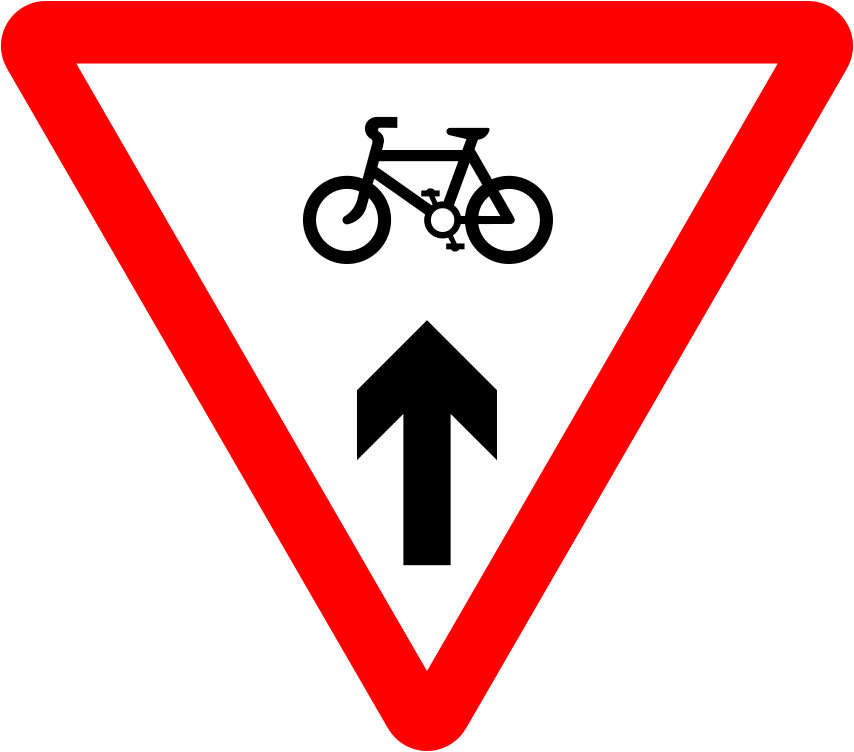
    At a set of traffic lights, this sign is mounted with the signals. What is it telling you?

    • APedal cycles, e-mopeds and electric scooters must not go past
    • BTurn right here
    • CCyclists and e-moped or electric scooter drivers must yield to pedestrians and trafficCorrect answer
    • DA track shared by pedestrians and cyclists
    Show the answerHide the answer

    Correct answer: C

    The picture shows the yield sign for cyclists. Part 3 of Schedule 2 to the Road Traffic (Traffic Signs) Regulations 2025 says it is used with traffic lights and applies only to pedal cyclists and e-moped and electric scooter drivers, who under Regulation 29(2) must yield right of way to pedestrians and traffic.

    Citation

    Source: Road Traffic (Traffic Signs) Regulations 2025 (S.I. No. 433 of 2025), Regulation 29(2), (6); Schedule 2, Part 3, checked on 2026-09-16.

  7. Question 7

    Which one of these signs tells traffic at roadworks that it may go on?

    • ASign A
    • BSign BCorrect answer
    • CSign C
    • DSign D
    Show the answerHide the answer

    Correct answer: B

    Sign B is the GO disc used at roadworks. Regulation 32(3) of the Road Traffic (Traffic Signs) Regulations 2025 provides that when it faces your stream of traffic at roadworks, traffic may go on or start to go on. It may show GO or the Irish Téigh.

    Citation

    Source: Road Traffic (Traffic Signs) Regulations 2025 (S.I. No. 433 of 2025), Regulation 32(3), (4); Schedule 2, Part 5, checked on 2026-09-16.

  8. Question 8

    How is rear overhang measured on a rigid goods vehicle, and what is the cap?

    • AFrom the centre of the rear axle, or the midpoint between the rear two axles, to the rearmost point, and it must not exceed 60 per cent of the distance from the front wheel centre to that rear reference planeCorrect answer
    • BFrom the front bumper to the tail, and it must not exceed 50 per cent of the vehicle length
    • CFrom the king pin to the tail, and it must not exceed 12 metres
    • DFrom the cab rear to the tail, and it must not exceed 3 metres
    Show the answerHide the answer

    Correct answer: A

    Rear overhang is measured from the centre of the rear axle, or the midpoint between the rear two axles, to the rearmost point, and must not exceed 60 per cent of the distance from the front wheel centre to that rear reference plane. A 50 per cent body-length figure, a 12 metre king-pin figure, or a 3 metre cab-to-tail figure is not this rule. This is the rear overhang rule in regulations 46 and 47 of the Road Traffic (Construction and Use of Vehicles) Regulations 2003.

    Citation

    Source: Road Traffic (Construction and Use of Vehicles) Regulations 2003 (S.I. No. 5 of 2003), Regulation 46(2) and Regulation 47(1) and (2), checked on 2026-09-16.

  9. Question 9

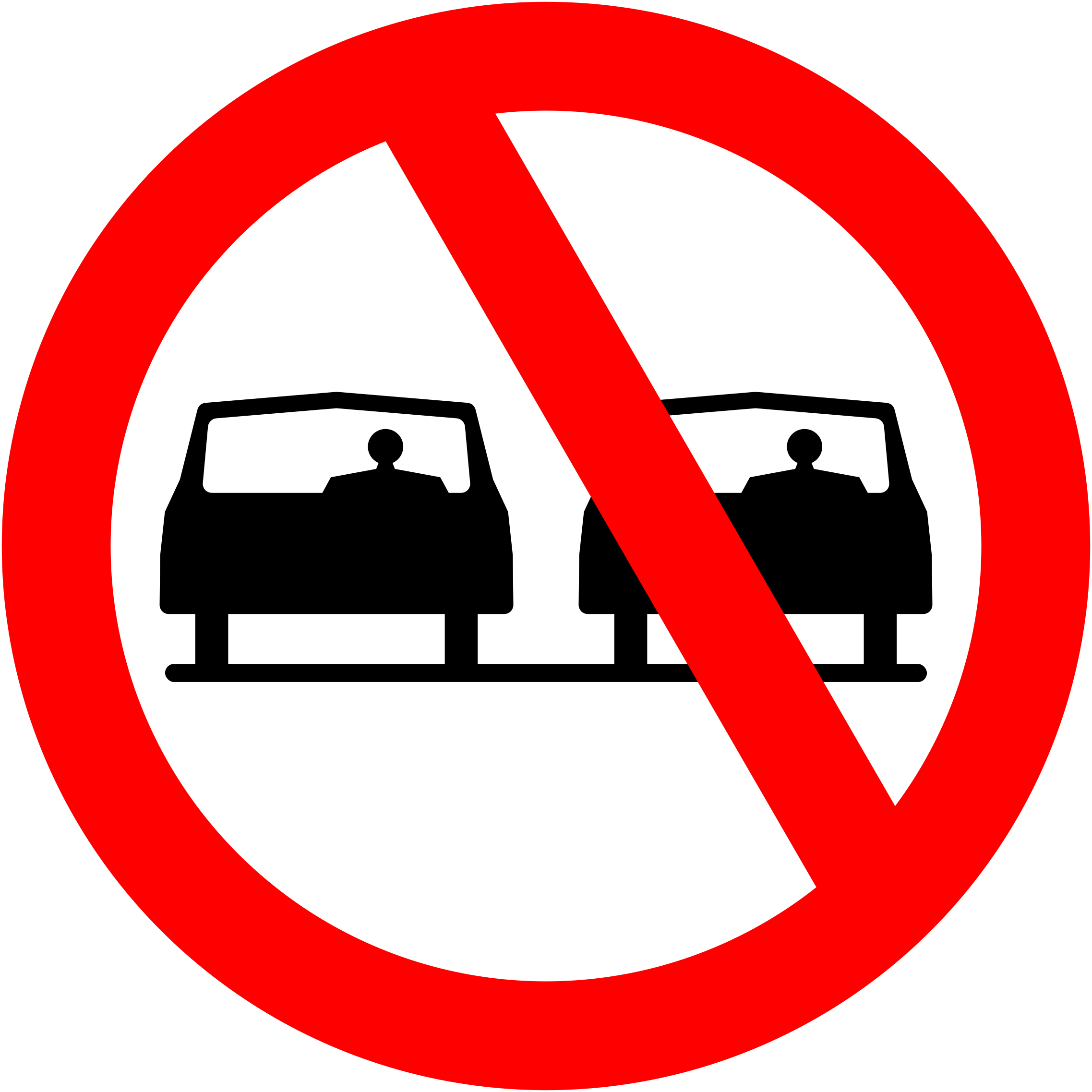
    Which sign bans overtaking?

    • ASign A
    • BSign B
    • CSign C
    • DSign DCorrect answer
    Show the answerHide the answer

    Correct answer: D

    Sign D is the no overtaking sign. It is a prohibitory sign in Part 1 of Schedule 2 to the Road Traffic (Traffic Signs) Regulations 2025. Article 10(3) of the Road Traffic (Traffic and Parking) Regulations 1997 says a driver must not overtake, or try to overtake, on a stretch of road where it is provided.

    Citation

    Source: Road Traffic (Traffic and Parking) Regulations 1997 (S.I. No. 182 of 1997), Article 10(3), as substituted by S.I. No. 473 of 2025, reg. 2(c), checked on 2026-09-16.

  10. Question 10

    The two axles of a tandem on your goods vehicle are 1.5 metres apart. What is the tandem weight limit, without the extra 19 tonne conditions?

    • A16 tonnes
    • B18 tonnesCorrect answer
    • C11.5 tonnes
    • D24 tonnes
    Show the answerHide the answer

    Correct answer: B

    At 1.3 metres to under 1.8 metres the tandem limit is 18 tonnes unless the extra driving-axle conditions for 19 tonnes are met. 16 tonnes is the tighter spacing band, 11.5 tonnes is the under 1.0 metre band, and 24 tonnes is a triaxle figure. This is the tandem axle weight rule in regulation 6 of the Road Traffic (Construction and Use of Vehicles) Regulations 2003, as substituted by the Road Traffic (Construction and Use of Vehicles) (Amendment) (No. 2) Regulations 2014.

    Citation

    Source: Road Traffic (Construction and Use of Vehicles) Regulations 2003 (S.I. No. 5 of 2003), Regulation 6(1)(a) to (c), as substituted by Regulation 7(a) of S.I. No. 253 of 2014, checked on 2026-09-16.

  11. Question 11

    What is the ordinary daily driving time limit under the EU drivers' hours rules?

    • A8 hours
    • B9 hoursCorrect answer
    • C11 hours
    • D12 hours
    Show the answerHide the answer

    Correct answer: B

    The daily driving time shall not exceed nine hours. A longer day is a limited exception, not the ordinary cap, and 8, 11 or 12 hours are not the figure. This is the daily driving limit in Article 6 of Regulation (EC) No 561/2006.

    Citation

    Source: Regulation (EC) No 561/2006 on the harmonisation of certain social legislation relating to road transport, Article 6(1), checked on 2026-09-15.

  12. Question 12

    Where must the disc attached to a goods vehicle's certificate of roadworthiness be displayed?

    • AOn the front windscreen where the vehicle has one, and otherwise on the near side where it is clearly visibleCorrect answer
    • BInside the tachograph head, out of sight
    • COn the rear doors only
    • DIn the operator's office, not on the vehicle
    Show the answerHide the answer

    Correct answer: A

    The disc must be displayed on the front windscreen where the vehicle has one, and otherwise on the near side where it is clearly visible. Hiding it in the tachograph, putting it only on the rear doors, or leaving it in the office is not the rule. This is the disc display rule in regulation 27 of the Commercial Vehicle Roadworthiness (Vehicle Testing) (No. 2) Regulations 2013.

    Citation

    Source: Commercial Vehicle Roadworthiness (Vehicle Testing) (No. 2) Regulations 2013 (S.I. No. 347 of 2013), Regulation 27(2)(a) and (b), checked on 2026-09-16.

  13. Question 13

    How often must you use a record sheet or your driver card?

    • AOnly on international work
    • BEvery day on which you driveCorrect answer
    • COnly on days with a long run
    • DOnce a week when you return to the depot
    Show the answerHide the answer

    Correct answer: B

    Drivers shall use record sheets or driver cards every day on which they drive. The duty is not limited to international work or long runs, and a weekly return to the depot is not the recording interval. This is the recording duty in Article 34 of Regulation (EU) No 165/2014.

    Citation

    Source: Regulation (EU) No 165/2014 on tachographs in road transport, Article 34(1), checked on 2026-09-15.

  14. Question 14

    When is the first commercial vehicle roadworthiness test due on a goods vehicle?

    • AOn the third anniversary of first registration
    • BSix months after first registration
    • COnly when the owner sells the vehicle
    • DOn the first anniversary of its first registrationCorrect answer
    Show the answerHide the answer

    Correct answer: D

    The first test for a goods vehicle is due on the first anniversary of its first registration. The third anniversary, six months, or a sale is not the first due date. This is the test due date rule in regulation 6 of the Commercial Vehicle Roadworthiness (Vehicle Testing) (No. 2) Regulations 2013, as substituted by the Commercial Vehicle Roadworthiness (Vehicle Testing) (Amendment) Regulations 2018.

    Citation

    Source: Commercial Vehicle Roadworthiness (Vehicle Testing) (No. 2) Regulations 2013 (S.I. No. 347 of 2013), Regulation 6(1)(b) and (2), as substituted by Regulation 5 of S.I. No. 117 of 2018, checked on 2026-09-16.

  15. Question 15Road sign

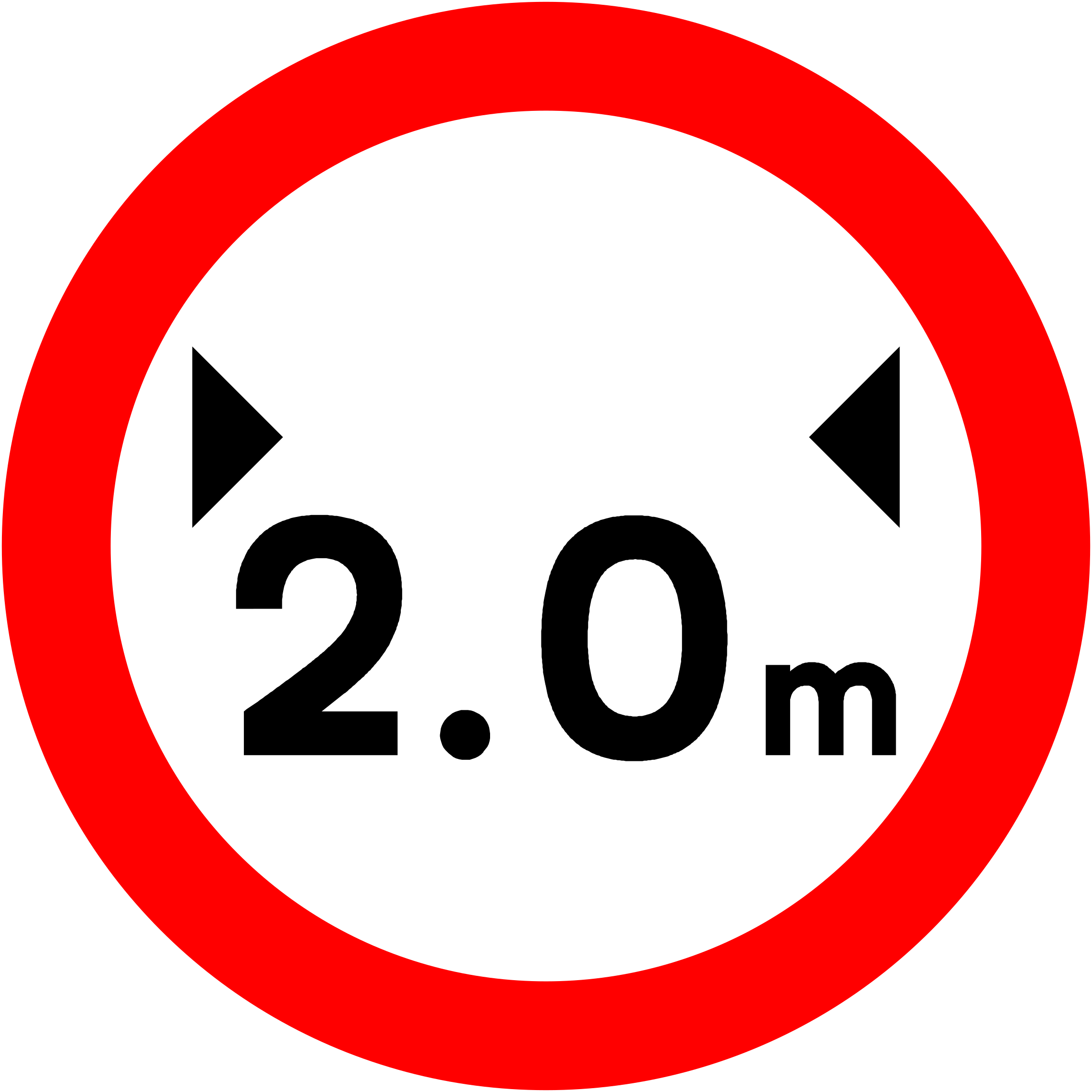
    You are about to turn onto a narrow road with tight bends and see this sign. What does it say you must not do?

    • ADrive past in a vehicle narrower than the width shown
    • BDrive past in a vehicle taller than that figure in metres
    • CDrive past in a vehicle wider than the width shownCorrect answer
    • DDrive past in a vehicle longer than that figure in metres
    Show the answerHide the answer

    Correct answer: C

    This is the maximum vehicle width sign. Regulation 26 of the Road Traffic (Traffic Signs) Regulations 2025 provides that the driver of a vehicle wider than the width shown, in metres, must not go past it. It does not limit height or length, and a narrower vehicle may go on.

    Citation

    Source: Road Traffic (Traffic Signs) Regulations 2025 (S.I. No. 433 of 2025), Regulation 26(1), (2); Schedule 2, Part 2, checked on 2026-09-16.

  16. Question 16

    You drive an Irish registered truck on an international journey that runs partly outside the European Union, Switzerland and the EEA. Which hours rules govern that journey?

    • AThe AETR applies instead of Regulation (EC) No 561/2006 for the whole journeyCorrect answer
    • BRegulation (EC) No 561/2006 applies in full for the whole journey
    • CThe hours rules of the country where the vehicle is registered always decide
    • DOnly Irish national hours rules apply, because the journey began in the State
    Show the answerHide the answer

    Correct answer: A

    For a vehicle registered in the Community, or in a country that is party to the AETR, the AETR applies instead of the Regulation for the whole of an international journey that runs partly outside the Community, Switzerland and the EEA. This is Article 2(3)(a) of Regulation (EC) No 561/2006, read with Article 2(2).

    Citation

    Source: Regulation (EC) No 561/2006 on the harmonisation of certain social legislation relating to road transport, Article 2(2), (3)(a), checked on 2026-09-16.

  17. Question 17

    When is an undertaking using goods vehicles outside the operator licensing rules?

    • AThey do not apply to undertakings using only vehicles or combinations not exceeding 3.5 tonnes engaged exclusively in national transport, nor to those using only vehicles not exceeding 2.5 tonnesCorrect answer
    • BThey always apply, whatever the weight or the work
    • CThey do not apply to any international goods work
    • DThey do not apply once a merchandise licence is held
    Show the answerHide the answer

    Correct answer: A

    The rules do not apply to undertakings using only vehicles or combinations not exceeding 3.5 tonnes engaged exclusively in national transport, nor to those using only vehicles not exceeding 2.5 tonnes. They are not universal, they do apply to international goods work above those figures, and a merchandise licence is not the exclusion. This is the operator licensing scope rule in Article 1 of Regulation (EC) No 1071/2009.

    Citation

    Source: Regulation (EC) No 1071/2009 of the European Parliament and of the Council of 21 October 2009 establishing common rules concerning the conditions to be complied with to pursue the occupation of road transport operator, Article 1(4)(a) and (aa), checked on 2026-09-16.

  18. Question 18

    You complete part of your compulsory periodic retraining in another Member State. Does that training count towards your current training cycle?

    • ANo, only training completed in the State counts
    • BNo, the training must be repeated in the State
    • CNo, training abroad counts only in the next training cycle
    • DYes, it is taken into consideration in the current training cycleCorrect answer
    Show the answerHide the answer

    Correct answer: D

    Compulsory periodic retraining completed in another Member State is taken into consideration in the current CPC training cycle. Training is not confined to the State. This is Regulation 12(8) of S.I. No. 359 of 2008, as inserted by S.I. No. 178 of 2020.

    Citation

    Source: European Union (Vehicle Drivers Certificate of Professional Competence) (Amendment) Regulations 2020 (S.I. No. 178 of 2020), Regulation 2(f)(ii), inserting Regulation 12(8) of S.I. No. 359 of 2008, checked on 2026-09-16.

  19. Question 19

    Who may ask you to produce your driver CPC?

    • AOnly a member of the Garda Síochána
    • BYour employer or the training centre that issued your records
    • CAny employee of the Authority, on production of an identity card
    • DA member of the Garda Síochána or a transport officerCorrect answer
    Show the answerHide the answer

    Correct answer: D

    A member of the Garda Síochána or a transport officer may ask a driver for the driver CPC at any time, and failure to produce it is an offence. This is Regulation 17(4) and (5) of S.I. No. 359 of 2008.

    Citation

    Source: European Communities (Vehicle Drivers Certificate of Professional Competence) (No. 2) Regulations 2008 (S.I. No. 359 of 2008), Regulation 17(4) and (5), checked on 2026-09-16.

  20. Question 20

    The sole driving axle on your rigid has twin tyres but not air suspension. What is the greatest weight that axle may put on the road?

    • A10 tonnes, the same as every other single axle
    • B10.5 tonnesCorrect answer
    • C11.5 tonnes without any further condition
    • D16 tonnes, as if it were a tandem axle
    Show the answerHide the answer

    Correct answer: B

    A sole driving axle with twin tyres is limited to 10.5 tonnes. 10 tonnes is the general single axle figure, 11.5 tonnes also needs air suspension or an equivalent system, and 16 tonnes is a tandem axle figure. This is the single axle weight rule in regulation 5 of the Road Traffic (Construction and Use of Vehicles) Regulations 2003, as substituted by the Road Traffic (Construction and Use of Vehicles) (Amendment) (No. 2) Regulations 2014.

    Citation

    Source: Road Traffic (Construction and Use of Vehicles) Regulations 2003 (S.I. No. 5 of 2003), Regulation 5(1) to (4), as substituted and inserted by Regulation 6 of S.I. No. 253 of 2014, checked on 2026-09-16.