Truck theory test

Free Truck Mock Theory Test: 100 Questions in 120 Minutes

The real format, with the real time limit. Find out where you stand.
  • 100questions
  • 120minutes
  • 74to pass
Source: Truck Theory Test, checked on 2026-09-15Start the mock testWarm up with a practice set

This free mock theory test for Ireland follows the truck test (C): 100 questions, 120 minutes on the clock and 74 correct to pass, which leaves 26 mistakes. Flag a question and change an answer before you finish. Source: Citizens Information, page edited 6 May 2026, checked on 15 September 2026.

How it works

What the mock test does

  • Timed like the real test

    A countdown runs for the full time allowed, so you practise your pace as well as your answers.

  • Flag and come back

    Mark any question you are unsure of and jump back to it from the question grid before you finish.

  • Results by topic

    Your score is broken down by study area, with a link to the lesson for each one you need to revisit.

  • Every answer explained

    Review each question afterwards with the explanation and the Irish law it comes from.

Official format

The official format

Question count, time limit and pass mark come from the official test description.

Theory test formats
TestQuestionsMinutesCorrect to pass
Truck (C)10012074

Source: Truck (C), 2026-05-06, checked on 2026-09-15

On the day

What the test screen lets you do

Timing display

A built-in countdown timer and progress tracking are shown on screen

Source: Prometric Ireland Ltd (Driver Theory Test Service), Accessibility and support options, dated 2026-06-11, checked on 2026-09-15

Skipping and flagging questions

Questions can be skipped or marked and returned to at any stage within the test time

Source: Prometric Ireland Ltd (Driver Theory Test Service), Driver Theory Test FAQs, dated 2026-08-14, checked on 2026-09-15

Changing and reviewing answers

An answer can be cancelled and another selected, and all answers can be reviewed and changed before finishing

Source: Prometric Ireland Ltd (Driver Theory Test Service), Driver Theory Test FAQs, dated 2026-08-14, checked on 2026-09-15

How questions are drawn

Questions are selected at random from the question bank for the relevant test sections

Source: Prometric Ireland Ltd (Driver Theory Test Service), Driver Theory Test FAQs, dated 2026-08-14, checked on 2026-09-15

Try it now

Sample questions and answers

1 of 20
  1. Question 1

    A third country national drives goods internationally for a haulier in the Community. How may the driver prove the CPC qualification?

    • ABy the driving licence alone
    • BBy a driver attestation bearing code 95Correct answer
    • CBy a letter from the employer confirming the driver experience
    • DBy a tachograph printout covering the last working week
    Show the answerHide the answer

    Correct answer: B

    A third country driver carrying goods may prove the qualification by a driver attestation bearing code 95. This is Article 10(2) and (3) of Directive (EU) 2022/2561.

    Citation

    Source: Directive (EU) 2022/2561 of the European Parliament and of the Council of 14 December 2022 on the initial qualification and periodic training of drivers of certain road vehicles for the carriage of goods or passengers, Article 10(2) and (3), checked on 2026-09-16.
  2. Question 2

    Heavy snow closes the motorway and the driver cannot reach a safe place to stop within the allowed driving time. What may the driver do?

    • ANothing, because the driving limits have no exceptions of any kind
    • BDepart from the rules as far as needed to reach a suitable stopping place and ensure the safety of persons, the vehicle or its loadCorrect answer
    • CContinue to the original destination, because weather never justifies a change
    • DStop on the hard shoulder and remain there until the road reopens
    Show the answerHide the answer

    Correct answer: B

    Provided road safety is not jeopardised, a driver may depart from Articles 6 to 9 as far as necessary to reach a suitable stopping place and to ensure the safety of persons, the vehicle or its load. This is the first paragraph of Article 12 of Regulation (EC) No 561/2006.

    Citation

    Source: Regulation (EC) No 561/2006 on the harmonisation of certain social legislation relating to road transport, Article 12, first paragraph, checked on 2026-09-16.

  3. Question 3

    The two axles of a tandem on your goods vehicle are less than 1.0 metre apart. What is the tandem weight limit?

    • A16 tonnes
    • B18 tonnes
    • C19 tonnes
    • D11.5 tonnesCorrect answer
    Show the answerHide the answer

    Correct answer: D

    A tandem axle under 1.0 metre apart is limited to 11.5 tonnes. 16 tonnes is the next spacing band, 18 tonnes is the band from 1.3 metres to under 1.8 metres, and 19 tonnes needs extra driving-axle conditions. This is the tandem axle weight rule in regulation 6 of the Road Traffic (Construction and Use of Vehicles) Regulations 2003, as substituted by the Road Traffic (Construction and Use of Vehicles) (Amendment) (No. 2) Regulations 2014.

    Citation

    Source: Road Traffic (Construction and Use of Vehicles) Regulations 2003 (S.I. No. 5 of 2003), Regulation 6(1)(a) to (c), as substituted by Regulation 7(a) of S.I. No. 253 of 2014, checked on 2026-09-16.

  4. Question 4

    A new category C truck has been built but not yet put into service, and it is being driven on a test run. Are the driver CPC regulations applied to it?

    • ANo, a new vehicle not yet in service is outside the regulationsCorrect answer
    • BYes, all category C vehicles are covered
    • CYes, unless the driver already holds a driver CPC
    • DYes, because the vehicle is on a public road
    Show the answerHide the answer

    Correct answer: A

    The regulations do not apply to a vehicle undergoing road tests for technical development, repair or maintenance, or to a new or rebuilt vehicle that has not yet been put into service. This is Regulation 6(2)(c) and (d) of S.I. No. 359 of 2008.

    Citation

    Source: European Communities (Vehicle Drivers Certificate of Professional Competence) (No. 2) Regulations 2008 (S.I. No. 359 of 2008), Regulation 6(2)(c) and (d), checked on 2026-09-16.

  5. Question 5

    How many hours of periodic Driver CPC training must you complete in each training period?

    • AAt least 28 hours
    • BAt least 40 hours
    • CAt least 35 hoursCorrect answer
    • DAt least 7 hours
    Show the answerHide the answer

    Correct answer: C

    Periodic training is a total of at least 35 hours in each training period. Seven hours is the size of each block, not the full total, and 28 or 40 hours are the wrong totals. This is the periodic training rule in the European Communities (Vehicle Drivers Certificate of Professional Competence) (No. 2) Regulations 2008.

    Citation

    Source: European Communities (Vehicle Drivers Certificate of Professional Competence) (No. 2) Regulations 2008 (S.I. No. 359 of 2008), Regulation 12(3) and Regulation 13, checked on 2026-09-15.

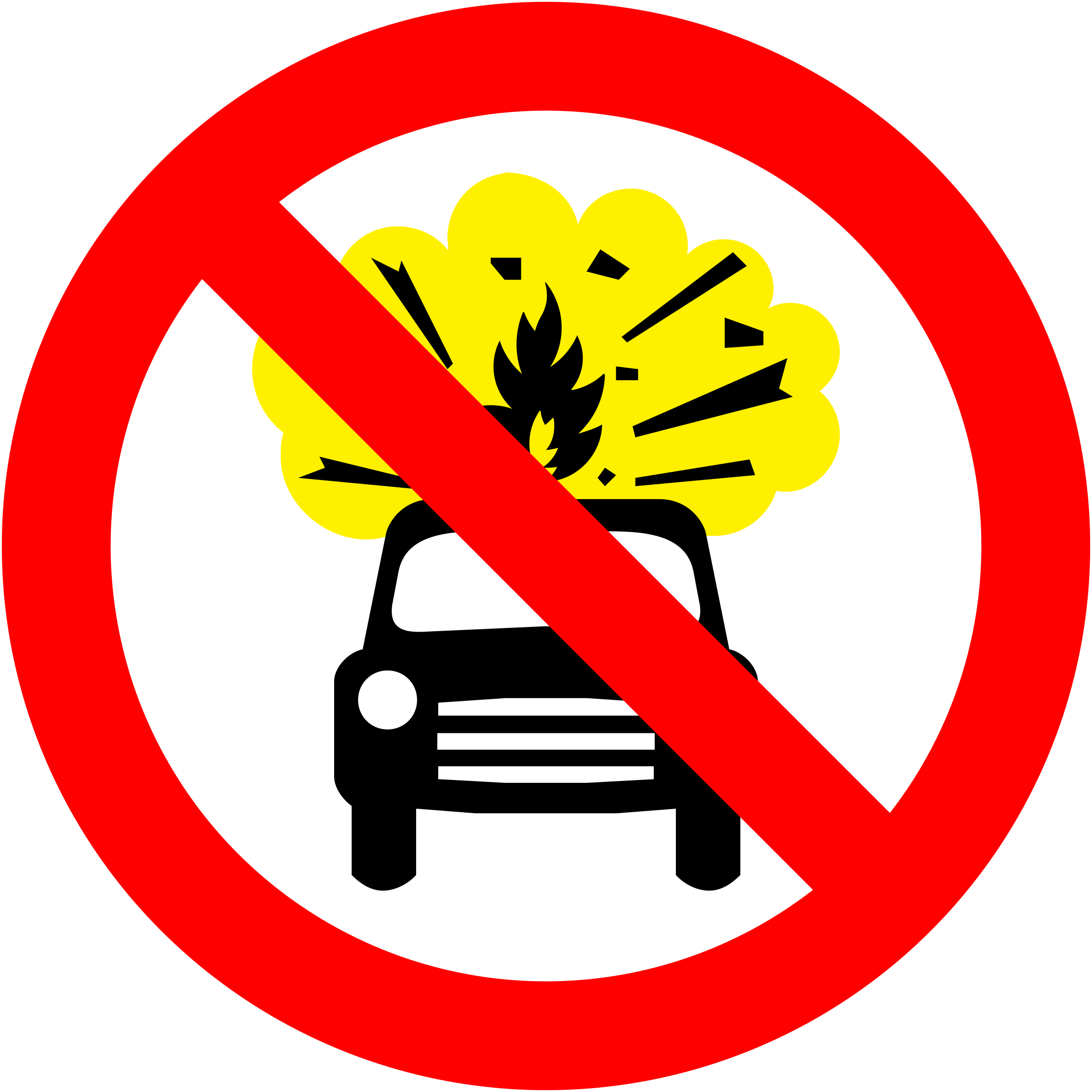
  6. Question 6Road sign

    You are approaching the entrance to a road tunnel and see this sign. What does this sign tell you not to do?

    • ADrive past in a car with passengers
    • BRide past on a motorcycle
    • CDrive past in a lorry carrying timber
    • DDrive past in a van carrying explosive materialCorrect answer
    Show the answerHide the answer

    Correct answer: D

    Regulation 20 of the Road Traffic (Traffic Signs) Regulations 2025 provides that, at or near the entrance to a road tunnel, the driver of a vehicle carrying explosive material must not go past this sign. A load of timber, passengers or a motorcycle on its own is not caught by it.

    Citation

    Source: Road Traffic (Traffic Signs) Regulations 2025 (S.I. No. 433 of 2025), Regulation 20(1), (4); Schedule 2, Part 1, checked on 2026-09-16.

  7. Question 7

    Your articulated goods vehicle must be able to be driven within which pair of concentric circles, without any part projecting outside?

    • A15 metres and 6 metres
    • BCircles of 12.50 metres and 5.30 metresCorrect answer
    • C10 metres and 4 metres
    • D12 metres and 2.04 metres
    Show the answerHide the answer

    Correct answer: B

    A mechanically propelled vehicle, articulated vehicle or combination must be able to be driven within concentric circles of 12.50 metres and 5.30 metres without any part projecting outside. 15 and 6, 10 and 4, and 12 and 2.04 are not that pair. This is the turning-circle rule in regulation 45 of the Road Traffic (Construction and Use of Vehicles) Regulations 2003, as amended by the Road Traffic (Construction and Use of Vehicles) (Amendment) Regulations 2017.

    Citation

    Source: Road Traffic (Construction and Use of Vehicles) Regulations 2003 (S.I. No. 5 of 2003), Regulation 45, as amended by Regulation 17 of S.I. No. 320 of 2017, checked on 2026-09-16.

  8. Question 8Road sign

    What is the meaning of this sign?

    • AThe height of the structure ahead, in metres
    • BA space only for electric vehicles that are rechargingCorrect answer
    • CA speed limit of 120 km/h
    • DA shared zone for pedestrians, cyclists and vehicles
    Show the answerHide the answer

    Correct answer: B

    You are looking at the electric vehicle recharging only sign. Part 2 of Schedule 2 to the Road Traffic (Traffic Signs) Regulations 2025 lists it among the restrictive signs made under Regulation 22. It keeps the space for electric vehicles while they recharge.

    Citation

    Source: Road Traffic (Traffic Signs) Regulations 2025 (S.I. No. 433 of 2025), Regulation 22(1); Schedule 2, Part 2, checked on 2026-09-16.

  9. Question 9

    A driver is working abroad for a haulier based in the State. Where must the driver be able to return to, under the four week rule?

    • AAny depot of the undertaking in any Member State
    • BThe employer operational centre in the establishment State, or the driver place of residenceCorrect answer
    • CThe place where the driver first took charge of the vehicle
    • DThe head office of the customer the driver serves most often
    Show the answerHide the answer

    Correct answer: B

    The return is to the employer operational centre in the establishment State, or to the driver place of residence, so that a qualifying weekly rest can be spent there. This is Article 8(8a) of Regulation (EC) No 561/2006.

    Citation

    Source: Regulation (EC) No 561/2006 on the harmonisation of certain social legislation relating to road transport, Article 8(8a), checked on 2026-09-16.

  10. Question 10

    A goods vehicle is modified so that it has more than four axles. Besides the 36 tonne cap, what else must it have?

    • AABS or EBS, and air suspensionCorrect answer
    • BA second steering axle only
    • CA drawbar trailer on every run
    • DA speed limiter set below the ordinary goods figure
    Show the answerHide the answer

    Correct answer: A

    A vehicle modified to more than four axles has the same 36 tonne cap and needs ABS or EBS and air suspension. A second steering axle, a drawbar trailer, or a lower speed limiter setting is not that condition. This is the extra-axle rigid weight rule in regulations 11A and 11B of the Road Traffic (Construction and Use of Vehicles) Regulations 2003, as inserted by the Road Traffic (Construction and Use of Vehicles) (Amendment) Regulations 2018.

    Citation

    Source: Road Traffic (Construction and Use of Vehicles) Regulations 2003 (S.I. No. 5 of 2003), Regulations 11A(2) and (4) and 11B(2), (3) and (4), as inserted by Regulation 6 of S.I. No. 23 of 2018, checked on 2026-09-16.

  11. Question 11

    Does the commercial vehicle roadworthiness test apply to goods trailers of categories O3 and O4?

    • ANo, trailers are outside the test
    • BYes, but only where the design speed is under 25 km/h
    • CYes, among other vehicles, where the design speed exceeds 25 km/hCorrect answer
    • DNo, only the drawing vehicle is tested
    Show the answerHide the answer

    Correct answer: C

    Goods trailers of categories O3 and O4 sit inside the test, among other vehicles, where the design speed exceeds 25 km/h. Trailers are not outside it, the speed condition is not under 25 km/h, and the drawing vehicle is not the only unit tested. This is the testing scope rule in regulation 4 of the Commercial Vehicle Roadworthiness (Vehicle Testing) (No. 2) Regulations 2013, as substituted by the Commercial Vehicle Roadworthiness (Vehicle Testing) (Amendment) Regulations 2018.

    Citation

    Source: Commercial Vehicle Roadworthiness (Vehicle Testing) (No. 2) Regulations 2013 (S.I. No. 347 of 2013), Regulation 4(1)(b) and (c), as substituted by Regulation 4 of S.I. No. 117 of 2018, checked on 2026-09-16.

  12. Question 12Road sign

    How should you read this sign?

    • AYou may pass the sign on either side
    • BA track shared by pedestrians and cyclistsCorrect answer
    • CTurn right at the junction ahead
    • DA speed limit of 100 km/h
    Show the answerHide the answer

    Correct answer: B

    You are looking at the shared track sign. Regulation 6 of the Road Traffic (Traffic Signs) Regulations 2025 provides that, with the matching road markings, it indicates a track shared by pedestrians and people on pedal cycles, e-mopeds or electric scooters.

    Citation

    Source: Road Traffic (Traffic Signs) Regulations 2025 (S.I. No. 433 of 2025), Regulation 6(1); Schedule 1, Part 2, checked on 2026-09-16.

  13. Question 13

    What is the general laden weight limit for a four-axle rigid goods vehicle or trailer?

    • A30 tonnesCorrect answer
    • B32 tonnes in every case
    • C26 tonnes
    • D36 tonnes
    Show the answerHide the answer

    Correct answer: A

    A four-axle rigid vehicle or trailer is limited to 30 tonnes laden as the general rule. 32 tonnes needs twin tyres and air suspension on each driving axle, or twin tyres and two driving axles neither exceeding 9.5 tonnes. 26 tonnes is a three-axle figure and 36 tonnes is an extra-axle cap. This is the four-axle rigid laden weight rule in regulation 11 of the Road Traffic (Construction and Use of Vehicles) Regulations 2003.

    Citation

    Source: Road Traffic (Construction and Use of Vehicles) Regulations 2003 (S.I. No. 5 of 2003), Regulation 11(1) and (2), checked on 2026-09-16.

  14. Question 14

    One of these signs marks a track shared by pedestrians and cyclists. Which one?

    • ASign A
    • BSign B
    • CSign CCorrect answer
    • DSign D
    Show the answerHide the answer

    Correct answer: C

    Sign C is the shared track sign. Regulation 6 of the Road Traffic (Traffic Signs) Regulations 2025 provides that, with the matching road markings, it indicates a track shared by pedestrians and people on pedal cycles, e-mopeds or electric scooters.

    Citation

    Source: Road Traffic (Traffic Signs) Regulations 2025 (S.I. No. 433 of 2025), Regulation 6(1); Schedule 1, Part 2, checked on 2026-09-16.

  15. Question 15

    Your driver qualification card has expired, your driving licence is valid but does not bear code 95, and you have finished your periodic training. May you drive a category C truck while you wait for the new card?

    • AYes, because the periodic training is complete
    • BYes, because the driving licence remains valid
    • CNo, the duty is to hold a valid driver CPC, and driving without one is an offenceCorrect answer
    • DYes, for up to one month after the card expires
    Show the answerHide the answer

    Correct answer: C

    The duty is to hold a valid driver CPC, and a person must not drive a relevant vehicle without one. The card expiring does not end the duty, and driving in the meantime is an offence. This is Regulation 23(1)(a) and (b) of S.I. No. 359 of 2008, as substituted by S.I. No. 594 of 2025.

    Citation

    Source: European Union (Vehicle Drivers Certificate of Professional Competence) Regulations 2025 (S.I. No. 594 of 2025), Regulation 2(f)(i), substituting Regulation 23(1)(a) and (b) of S.I. No. 359 of 2008, checked on 2026-09-16.

  16. Question 16

    What is the general laden weight limit for a five-axle articulated goods vehicle?

    • A42 tonnes in every case
    • B44 tonnes in every case
    • C38 tonnes
    • D40 tonnesCorrect answer
    Show the answerHide the answer

    Correct answer: D

    A five-axle articulated vehicle is limited to 40 tonnes laden as the general rule. 42 tonnes is for an appropriate motor vehicle with a two-axle appropriate semi-trailer, 44 tonnes is the 40 foot ISO container intermodal figure, and 38 tonnes is a four-axle articulated figure. This is the five-axle articulated weight rule in regulation 14 of the Road Traffic (Construction and Use of Vehicles) Regulations 2003, as amended by the Road Traffic (Construction and Use of Vehicles) (Amendment) Regulations 2013.

    Citation

    Source: Road Traffic (Construction and Use of Vehicles) Regulations 2003 (S.I. No. 5 of 2003), Regulation 14(1), (3) and (4), as amended by Regulation 2(j) and (k) of S.I. No. 43 of 2013, checked on 2026-09-16.

  17. Question 17

    When is a recut tyre barred on a goods vehicle?

    • AOn any goods vehicle over 7.5 tonnes, with no further condition
    • BOn a goods vehicle under 2,540 kilograms unladen or with a rim under 405 millimetres, or where the recutting has cut or exposed the ply or cordCorrect answer
    • COn a trailer only
    • DOn a vehicle with air suspension only
    Show the answerHide the answer

    Correct answer: B

    A recut tyre must not be fitted to a goods vehicle under 2,540 kilograms unladen or with a rim under 405 millimetres, nor where the recutting has cut or exposed the ply or cord. A blanket ban over 7.5 tonnes, a trailer-only ban, or an air-suspension ban is not the rule. This is the recut tyre rule in regulation 56 of the Road Traffic (Construction and Use of Vehicles) Regulations 2003.

    Citation

    Source: Road Traffic (Construction and Use of Vehicles) Regulations 2003 (S.I. No. 5 of 2003), Regulation 56(1)(b) and (2)(a), checked on 2026-09-16.

  18. Question 18

    At what rear overhang must a load carry a red warning flag or marker by day?

    • AOnce the overhang passes 2 metres
    • BOnce the overhang passes 1 metreCorrect answer
    • COnce the overhang passes 3 metres
    • DAn amber marker is enough at any overhang
    Show the answerHide the answer

    Correct answer: B

    A load that projects more than one metre to the rear must carry a red warning flag or marker by day. Waiting until 2 metres or 3 metres is too late, and an amber marker is not the day marker this rule requires. This is the load overhang rule in the Road Traffic (Construction and Use of Vehicles) Regulations 2003.

    Citation

    Source: Road Traffic (Construction and Use of Vehicles) Regulations 2003 (S.I. No. 5 of 2003), Regulations 33, 34 and 35(2), checked on 2026-09-15.

  19. Question 19

    Your two-axle rigid has 3 metres or more from the front axle to the rear axle. What is the greatest laden weight?

    • A16 tonnes
    • B20 tonnes
    • C18 tonnesCorrect answer
    • D22 tonnes
    Show the answerHide the answer

    Correct answer: C

    At 3 metres or more from front to rear axle a two-axle vehicle is limited to 18 tonnes laden. 16 tonnes is the under 3 metre figure, and 20 and 22 tonnes are not that two-axle figure. This is the two-axle laden weight rule in regulation 9 of the Road Traffic (Construction and Use of Vehicles) Regulations 2003, as substituted by the Road Traffic (Construction and Use of Vehicles) (Amendment) Regulations 2017.

    Citation

    Source: Road Traffic (Construction and Use of Vehicles) Regulations 2003 (S.I. No. 5 of 2003), Regulation 9(1) and (2), as substituted by Regulation 7 of S.I. No. 320 of 2017, checked on 2026-09-16.

  20. Question 20

    What is an indivisible load for that EU oversize rule?

    • AAny load over 20 tonnes, whatever its shape
    • BAny container, because a container cannot be opened on the road
    • CAny load that the customer asks to keep in one piece
    • DA load that cannot be divided into two or more loads for carriage by road without undue expense or risk of damage, and that cannot be carried by a vehicle or combination that complies with the Directive in all respectsCorrect answer
    Show the answerHide the answer

    Correct answer: D

    An indivisible load cannot be divided into two or more loads for carriage by road without undue expense or risk of damage, and cannot be carried by a vehicle or combination complying with the Directive in all respects. Weight alone, a container, or the customer's wish is not the definition. This is the indivisible load definition in Article 2 of Council Directive 96/53/EC.

    Citation

    Source: Council Directive 96/53/EC of 25 July 1996 laying down for certain road vehicles circulating within the Community the maximum authorized dimensions in national and international traffic and the maximum authorized weights in international traffic, Article 2, definition of indivisible load, checked on 2026-09-16.