If you are going for a truck licence in Ireland, the theory test you sit is the category C test, and one pass carries across the truck categories named below. It is the long paper rather than the car one, and it reads like a professional exam: the rules of the road sit alongside driving hours, the tachograph, loading and the limits that attach to a heavy vehicle.
What is on the truck paper that is not on the car paper
The rules of the road are still there, and a driver who has held a car licence for years will recognise most of that material. Beside it sits a body of law that only bites once the vehicle is heavy: how long you may drive, what the recording equipment must show, how the load is carried, and limits that follow the vehicle rather than the road. That half is where the study time goes.
The hours rules come from Regulation (EC) No 561/2006. Driving is capped at nine hours in a day, stretched to ten on no more than two days in a week, and a break of 45 minutes falls due after four and a half hours at the wheel, which may be taken as 15 minutes followed by 30. Weekly driving stops at 56 hours, and any two consecutive weeks at 90.
The tachograph rules sit next to them in Regulation (EU) No 165/2014. A record sheet or driver card is used on every day you drive, from the moment you take the vehicle over, and the card with the records for that day and the previous 56 days travels in the cab with you. Questions here are about the paperwork rather than the road craft, which catches people out.
Speed, load and the shape of the vehicle
Speed is the most reliable trap on the paper. A goods vehicle over 3,500 kg has its own ordinary limits under the Road Traffic (Ordinary Speed Limits - Buses, Heavy Goods Vehicles, etc) Regulations 2008 as amended: 90 km/h on a motorway and 80 km/h on every other road, towing or not. The sign at the roadside does not raise that, and the same class of vehicle carries a speed limiter set at 90 km/h, so the answer is settled before you touch the accelerator.
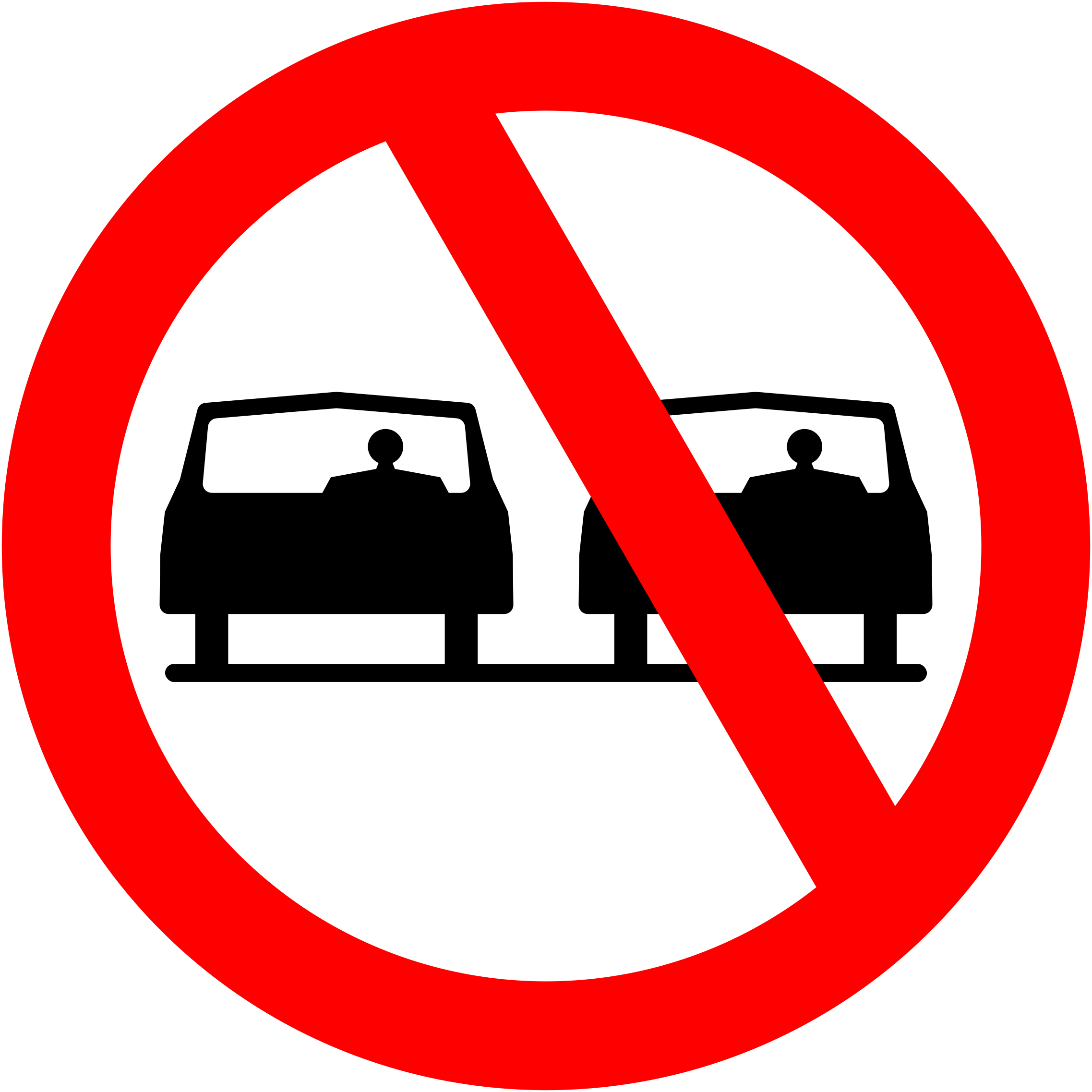
That limit has a knock-on effect people miss. Because the vehicle cannot exceed 90 km/h, the Road Traffic (Traffic and Parking) Regulations 1997, as amended, keep it out of the right-hand lane of a motorway that has more than one lane, unless an obstruction or a lane closure forces it across. The lane rule comes from the vehicle, not from the driving.
Loading is treated the same way. A load may not overhang the sides by more than 300 mm or the rear by more than 3 metres, and anything projecting more than a metre beyond the rear needs a red flag or marker by day. Dimensions, weights and axle limits come from the construction and use regulations rather than from anything judged by eye, so they are learned rather than worked out.
Where the theory pass sits in the route to a truck licence
A truck permit is not a first permit. It is granted on top of entitlement you already hold, and the rows above set out what has to be in place before it can issue. The order is where the lost time goes: a candidate passes the theory test, then finds that the rest of the paperwork has months in it while the certificate sits there ageing.
Once a permit is in hand the driving is tightly restricted. A truck learner must be accompanied and supervised by a qualified person, except while the driving test itself is under way, and must not tow a trailer, both under the Road Traffic (Licensing of Drivers) Regulations 2006. Learner permit holders of every category are kept off motorways by the Roads Regulations 1994, an odd constraint when the work being trained for is largely motorway work.
A licence on its own still does not let you drive for hire or reward. Professional driving needs an initial Driver CPC under the European Communities (Vehicle Drivers Certificate of Professional Competence) (No. 2) Regulations 2008, kept current by 35 hours of periodic training every five years in blocks of seven hours, with proof carried in the cab: a Driver Qualification Card, or a licence showing code 95. The CPC is also what brings the minimum driving ages down, which is why the ages above come in pairs.
Whatever practice is offered on this page draws on the same ground the paper covers. Work through it, then go back to the instruments cited below for anything that did not sit right.
Sources
Source: eur-lex.europa.eu, Regulation (EC) No 561/2006, arts. 4, 6, 7 and 8, checked on 2026-09-16
Source: eur-lex.europa.eu, Regulation (EU) No 165/2014, arts. 34 and 36, checked on 2026-09-16
Source: irishstatutebook.ie, Road Traffic (Ordinary Speed Limits - Buses, Heavy Goods Vehicles, etc) (Amendment) Regulations 2022, reg. 2(b), checked on 2026-09-16
Source: irishstatutebook.ie, European Communities (Installation and Use of Speed Limitation Devices in Motor Vehicles) Regulations 2005, reg. 4(1) and Schedule, checked on 2026-09-16
Source: irishstatutebook.ie, Road Traffic (Traffic and Parking) (Amendment) Regulations 2024, art. 33(1)(d) and (e), checked on 2026-09-16
Source: irishstatutebook.ie, Road Traffic (Construction and Use of Vehicles) Regulations 2003, regs. 33, 34 and 35(2), checked on 2026-09-16
Source: irishstatutebook.ie, Road Traffic (Licensing of Drivers) Regulations 2006, reg. 17(6)(b)(iv) and (vi), checked on 2026-09-16
Source: irishstatutebook.ie, Roads Regulations 1994, art. 7(2)(a), checked on 2026-09-16
Source: irishstatutebook.ie, European Communities (Vehicle Drivers Certificate of Professional Competence) (No. 2) Regulations 2008, regs. 7, 12, 13 and 17, checked on 2026-09-16