Car theory test

Free Mock Theory Test Ireland: 40 Questions, 35 to Pass (Car)

The real format, with the real time limit. Find out where you stand.
  • 40questions
  • 45minutes
  • 35to pass
Source: Car/Tractor & Work Vehicles Theory Test, checked on 2026-09-15Start the mock testWarm up with a practice set

This free mock theory test for Ireland follows the car test (BW): 40 questions, 45 minutes on the clock and 35 correct to pass, which leaves 5 mistakes. Flag a question and change an answer before you finish. Source: Citizens Information, page edited 6 May 2026, checked on 15 September 2026.

How it works

What the mock test does

  • Timed like the real test

    A countdown runs for the full time allowed, so you practise your pace as well as your answers.

  • Flag and come back

    Mark any question you are unsure of and jump back to it from the question grid before you finish.

  • Results by topic

    Your score is broken down by study area, with a link to the lesson for each one you need to revisit.

  • Every answer explained

    Review each question afterwards with the explanation and the Irish law it comes from.

Official format

The official format

Question count, time limit and pass mark come from the official test description.

Theory test formats
TestQuestionsMinutesCorrect to pass
Car, tractor and work vehicle (BW)404535

Source: Car, tractor and work vehicle (BW), 2026-05-06, checked on 2026-09-15

On the day

What the test screen lets you do

Timing display

A built-in countdown timer and progress tracking are shown on screen

Source: Prometric Ireland Ltd (Driver Theory Test Service), Accessibility and support options, dated 2026-06-11, checked on 2026-09-15

Skipping and flagging questions

Questions can be skipped or marked and returned to at any stage within the test time

Source: Prometric Ireland Ltd (Driver Theory Test Service), Driver Theory Test FAQs, dated 2026-08-14, checked on 2026-09-15

Changing and reviewing answers

An answer can be cancelled and another selected, and all answers can be reviewed and changed before finishing

Source: Prometric Ireland Ltd (Driver Theory Test Service), Driver Theory Test FAQs, dated 2026-08-14, checked on 2026-09-15

How questions are drawn

Questions are selected at random from the question bank for the relevant test sections

Source: Prometric Ireland Ltd (Driver Theory Test Service), Driver Theory Test FAQs, dated 2026-08-14, checked on 2026-09-15

Try it now

Sample questions and answers

1 of 20
  1. Question 1

    From 1 November 2026, will proof that you booked a driving test secure a one year permit in the car, tractor, moped or motorcycle categories?

    • AYes, whenever a booking reference is shown
    • BYes, on two successive applications
    • CNo, you must have sat the driving testCorrect answer
    • DYes, if the test is within 3 months
    Show the answerHide the answer

    Correct answer: C

    From 1 November 2026, regulation 19(1)(b) of the Road Traffic (Licensing of Drivers) Regulations 2006 removes a booked test as a route to that permit, so the test must have been sat.

    Citation

    Source: Road Traffic (Licensing of Drivers) (Amendment) (No. 2) Regulations 2025 (S.I. No. 527 of 2025), Regulation 2(b), new Regulation 19(1)(b) of S.I. No. 537 of 2006, in operation 1 November 2026, checked on 2026-09-15.

  2. Question 2

    A no right turn sign on a city street has a plate reading Except Buses and Taxis, with the Irish legend Ach Amháin Busanna agus Tacsaithe. Who does that plate let through?

    • AEvery vehicle outside business hours
    • BMotorcycles as well as buses
    • CAnyone, because the plate is only advice
    • DLarge public service vehicles and taxisCorrect answer
    Show the answerHide the answer

    Correct answer: D

    Regulation 14 of the Road Traffic (Traffic Signs) Regulations 2025 allows that plate only under the no straight ahead, no right turn and no left turn signs. It means the prohibition does not apply to large public service vehicles and taxis. It does not open the turn to everyone outside business hours, and it does not cover motorcycles.

    Citation

    Source: Road Traffic (Traffic Signs) Regulations 2025 (S.I. No. 433 of 2025), Regulation 14(5), checked on 2026-09-15.

  3. Question 3

    After its first NCT, what is the normal testing pattern for a car through 30 years of age?

    • AEvery year from its first test onward
    • BEvery 3 years until age 12, then every year
    • CEvery 2 years from first registration throughout the whole life of the car
    • DEvery 2 years up to 10 years, then every year from 10 to 30 yearsCorrect answer
    Show the answerHide the answer

    Correct answer: D

    Regulation 3 of the Road Traffic (National Car Test) Regulations 2017 sets tests every 2 years up to 10 years of age and yearly from 10 to 30 years.

    Citation

    Source: Road Traffic (National Car Test) Regulations 2017 (S.I. No. 415 of 2017), Regulation 3(1)(c) and (2)(a), checked on 2026-09-15.

  4. Question 4

    The electrically powered vehicle symbol is painted in white on the roadway, without car share words. What does that marking show?

    • AA parking bay for any small vehicle
    • BA disabled persons' parking bay
    • CAn electrically powered vehicle recharging bayCorrect answer
    • DA bay for hybrid vehicles
    Show the answerHide the answer

    Correct answer: C

    Regulation 85 of the Road Traffic (Traffic Signs) Regulations 2025 provides that the electrically powered vehicle symbol painted in white on the roadway indicates an electrically powered vehicle recharging bay. It is not a general small-vehicle bay, a disabled persons' bay, or a hybrid-vehicle bay.

    Citation

    Source: Road Traffic (Traffic Signs) Regulations 2025 (S.I. No. 433 of 2025), Regulation 85(1), (2), checked on 2026-09-15.

  5. Question 5

    A driver tests below the measured alcohol limit but drink has left the driver unable to control the car properly. Is this an offence?

    • ANo, because only the measured limit matters
    • BNo, unless a collision occurs
    • CYes, inability to control the car is enoughCorrect answer
    • DYes, but only on a motorway
    Show the answerHide the answer

    Correct answer: C

    Road Traffic Act 2010, section 4 makes it an offence to drive while affected by an intoxicant so that proper control is lost.

    Citation

    Source: Road Traffic Act 2010 (No. 25 of 2010), Section 4(1), checked on 2026-09-15.

  6. Question 6

    You are travelling along a one-way street that has a contra-flow cycling sign. A cyclist is coming towards you. What is the position?

    • AThe cyclist is allowed to travel against the one-way flowCorrect answer
    • BThe cyclist is breaking the law, so you may hold the centre of the road
    • COnly e-scooters may travel against the one-way flow
    • DYou must reverse to let the cyclist through
    Show the answerHide the answer

    Correct answer: A

    Where the contra-flow cycling sign is provided, pedal cycles, e-mopeds and e-scooters may lawfully travel against the one-way direction. Article 14A of the Road Traffic (Traffic and Parking) Regulations 1997, inserted in October 2025, means you should expect them and allow for them. It does not order you to reverse.

    Citation

    Source: Road Traffic (Traffic and Parking) Regulations 1997 (S.I. No. 182 of 1997), Article 14A, inserted by S.I. No. 473 of 2025, reg. 2(d), checked on 2026-09-15.

  7. Question 7Road sign

    Where the traffic stream splits around an island, this sign stands at the near end. What message does it give?

    • ATurn left here
    • BKeep straight ahead
    • CYield right of way to traffic on the major road ahead
    • DKeep to the right of the signCorrect answer
    Show the answerHide the answer

    Correct answer: D

    This is the keep right sign. Regulation 4(1) of the Road Traffic (Traffic Signs) Regulations 2025 makes a blue mandatory disc show the direction or route traffic must take. This one, listed in Part 1 of Schedule 1, sends traffic to the right of it.

    Citation

    Source: Road Traffic (Traffic Signs) Regulations 2025 (S.I. No. 433 of 2025), Regulation 4(1)(a); Schedule 1, Part 1, checked on 2026-09-16.

  8. Question 8Road sign

    Driving along a city street with tram tracks, you see this sign. What is it telling you?

    • AA bus lane running with the flow of traffic
    • BA tram laneCorrect answer
    • CTrams must yield to other trams or to traffic on the road ahead
    • DU-turns are not allowed
    Show the answerHide the answer

    Correct answer: B

    You are looking at the nearside tram lane sign. Regulation 90(1) of the Road Traffic (Traffic Signs) Regulations 2025 provides that, with the tram lane line, it indicates a tram lane.

    Citation

    Source: Road Traffic (Traffic Signs) Regulations 2025 (S.I. No. 433 of 2025), Regulation 90(1), (2); Schedule 7, Part 5, checked on 2026-09-16.

  9. Question 9

    Which vehicles may stop or park inside bus stop markings?

    • ALarge public service vehiclesCorrect answer
    • BAny vehicle, for one minute
    • CAny vehicle lining up behind a bus
    • DGoods vehicles using it as a loading bay
    Show the answerHide the answer

    Correct answer: A

    Under Regulation 81 of the Road Traffic (Traffic Signs) Regulations 2025, the markings show the area in which vehicles other than large public service vehicles must not be stopped or parked. A one-minute wait, lining up, or treating it as a loading bay does not authorise other vehicles.

    Citation

    Source: Road Traffic (Traffic Signs) Regulations 2025 (S.I. No. 433 of 2025), Regulation 81(1), checked on 2026-09-15.

  10. Question 11

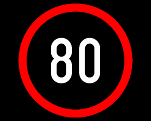
    What is the default limit for a rural regional road when no special or roadworks limit applies?

    • A120 km/h
    • B100 km/h
    • C80 km/hCorrect answer
    • D60 km/h
    Show the answerHide the answer

    Correct answer: C

    The regional road default outside a built-up area is 80 km/h under section 6(1) of the Road Traffic Act 2004, as substituted by the Road Traffic Act 2024.

    Citation

    Source: Road Traffic Act 2004 (No. 44 of 2004), s. 6(1), as substituted by Road Traffic Act 2024 (No. 10 of 2024), s. 7, checked on 2026-09-15.

  11. Question 12

    What does a no U-turn sign forbid, as against what a no right turn sign forbids?

    • AAny right turn, including into a side road
    • BReversing, but a U-turn is still allowed when the road is clear
    • CA U-turn only at a gap in a central reserve
    • DA U-turn past the sign, not a right turn into a side roadCorrect answer
    Show the answerHide the answer

    Correct answer: D

    Under Regulation 14 of the Road Traffic (Traffic Signs) Regulations 2025, the no U-turn sign and the no right turn sign are different prohibitory signs. No U-turn forbids a U-turn past the sign. No right turn forbids a right turn past its own sign. A clear road does not allow the U-turn, and the sign is not limited to gaps in a central reserve.

    Citation

    Source: Road Traffic (Traffic Signs) Regulations 2025 (S.I. No. 433 of 2025), Regulation 14(2)(c); Schedule 2, Part 1, checked on 2026-09-15.

  12. Question 13

    You drive a car on a public road during lighting-up hours. Which lamps must be lit throughout its use?

    • AOnly the headlamps
    • BOnly the side lamps
    • CThe rear lamps and the stop lamps
    • DThe side lamps, rear lamps and number plate lightingCorrect answer
    Show the answerHide the answer

    Correct answer: D

    The 1963 Lighting Regulations, article 20(1)(a), require lit side lamps, rear lamps and number plate lighting during lighting-up hours.

    Citation

    Source: Road Traffic (Lighting of Vehicles) Regulations 1963 (S.I. No. 189 of 1963), Article 20(1)(a), checked on 2026-09-15.

  13. Question 14

    What total stopping distance does RSA guidance give for 80 km/h in dry conditions?

    • A36 metres
    • B49 metres
    • C52 metresCorrect answer
    • D70 metres
    Show the answerHide the answer

    Correct answer: C

    RSA guidance in the Rules of the Road gives 16 metres for reaction and 36 metres for braking, making 52 metres in total.

    Citation

    Source: Rules of the Road, Road Safety Authority, Revision No. 9, May 2026 (guidance, not law), Stopping distances in dry conditions, Table 5, PDF page 125, checked on 2026-09-15.

  14. Question 15

    You see a disabled persons' parking bay marking on the roadway and no upright sign beside it. What does the marking show?

    • AA disabled persons' parking bayCorrect answer
    • BA loading bay until a sign is added
    • CA recharging bay
    • DAn advisory space because there is no upright sign
    Show the answerHide the answer

    Correct answer: A

    Under Regulation 67 of the Road Traffic (Traffic Signs) Regulations 2025, the marking indicates a disabled persons' parking bay. An upright sign is not required for that indication. It is not a loading bay or a recharging bay, and it is not merely advisory without a post.

    Citation

    Source: Road Traffic (Traffic Signs) Regulations 2025 (S.I. No. 433 of 2025), Regulation 67(1), checked on 2026-09-15.

  15. Question 16

    Pick the sign that marks a clearway.

    • ASign A
    • BSign B
    • CSign C
    • DSign DCorrect answer
    Show the answerHide the answer

    Correct answer: D

    Sign D is the clearway sign. It is one of the prohibitory signs in Part 1 of Schedule 2 to the Road Traffic (Traffic Signs) Regulations 2025. Regulation 14 lets a prohibitory sign forbid parking or stopping where it is provided, and a plate beneath can give the hours.

    Citation

    Source: Road Traffic (Traffic Signs) Regulations 2025 (S.I. No. 433 of 2025), Regulation 14(2)(d), (4); Schedule 2, Part 1, checked on 2026-09-16.

  16. Question 17

    A cyclist is ahead of you approaching a traffic island that narrows the road. What must you do?

    • AOvertake quickly to spend less time beside the cyclist
    • BSound the horn and overtake
    • CSqueeze past because the cyclist is close to the kerb
    • DWait until you can overtake without endangering or inconveniencing the cyclistCorrect answer
    Show the answerHide the answer

    Correct answer: D

    You must not overtake, or try to, if that would endanger or inconvenience a cyclist. A pinch point at a traffic island is a place where squeezing past does exactly that. Article 10(1) of the Road Traffic (Traffic and Parking) Regulations 1997 does not reward a quicker pass, a horn, or a tight gap at the kerb.

    Citation

    Source: Road Traffic (Traffic and Parking) Regulations 1997 (S.I. No. 182 of 1997), Article 10(1), as substituted by S.I. No. 473 of 2025, reg. 2(c), checked on 2026-09-15.

  17. Question 18

    You approach a blind bend on a narrow local road with a 60 km/h limit. How should you choose your speed?

    • AStay exactly 10 km/h below the limit
    • BDrive at 60 km/h if no vehicle is visible
    • CUse a speed that lets you stop within the clear distance you can seeCorrect answer
    • DKeep to the limit as long as your lights are on
    Show the answerHide the answer

    Correct answer: C

    The Traffic and Parking Regulations 1997, article 7, require a speed that allows you to stop within the clear distance visible. The limit is a maximum, not a target.

    Citation

    Source: Road Traffic (Traffic and Parking) Regulations 1997 (S.I. No. 182 of 1997), Article 7, checked on 2026-09-15.

  18. Question 19

    How many lessons make up Essential Driver Training for a car learner?

    • A12 lessonsCorrect answer
    • B6 lessons
    • C10 lessons
    • D20 lessons
    Show the answerHide the answer

    Correct answer: A

    Regulation 4 of the Road Traffic (Courses of Instruction) (Learner Permit Holders) Regulations 2011 sets Essential Driver Training at 12 lessons.

    Citation

    Source: Road Traffic (Courses of Instruction) (Learner Permit Holders) Regulations 2011 (S.I. No. 173 of 2011), Regulation 4, paragraphs (1) to (3) as substituted by S.I. No. 9 of 2019, checked on 2026-09-15.

  19. Question 20

    You see parking bays marked at right angles to the kerb, and others marked at an angle. What are those markings?

    • APerpendicular and angled parking bay markingsCorrect answer
    • BA guide only
    • CMarkings that apply only where there is a machine
    • DA layout that lets a long vehicle take two bays
    Show the answerHide the answer

    Correct answer: A

    Regulation 66 of the Road Traffic (Traffic Signs) Regulations 2025 includes perpendicular parking bay markings and angled parking bay markings among the signs that indicate parking bays on a public road. They are not a mere guide, they do not depend on a machine, and they do not authorise taking two bays.

    Citation

    Source: Road Traffic (Traffic Signs) Regulations 2025 (S.I. No. 433 of 2025), Regulation 66(1), checked on 2026-09-15.