Motorway Signs in Ireland and What They Mean
14 signs, each with what it means and the rule behind it.All 14 signs
Start of motorway
Everything about motorway driving starts at this sign: past it only a driving licence holder may drive, and a learner permit holder must not.
Motorway direction sign
Mainline direction signs for motorways are set out in section 2.4 of the directional information chapter of the Traffic Signs Manual, which is where their designs and wording live.
End of motorway
Past the end of motorway sign the motorway rules stop, and the limit becomes the default for the class of road you have joined (Road Traffic Act 2004, sections 5 to 7).
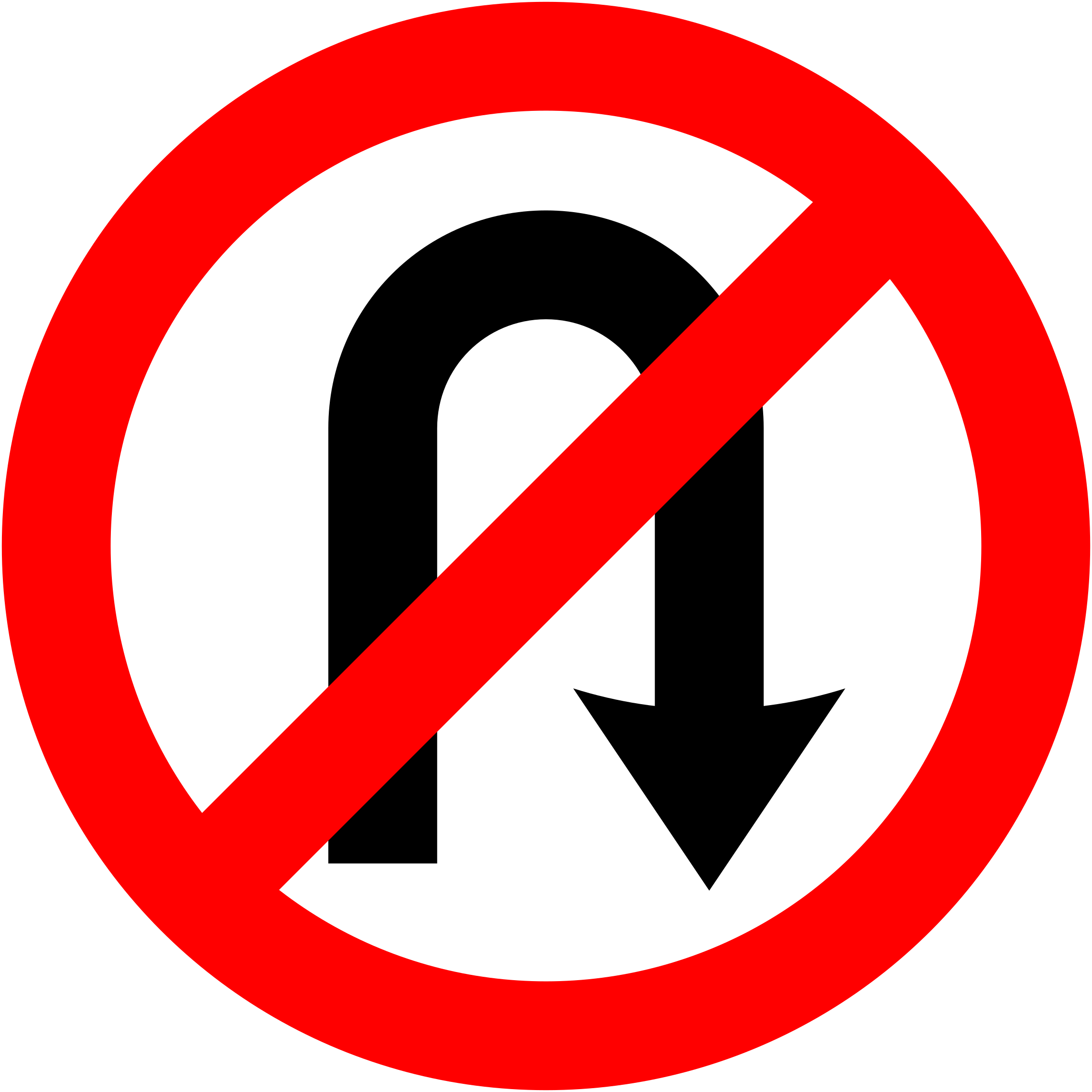
No U-Turn
On a dual carriageway or a road with a central reserve this sign bans a U-turn outright (article 35); on a motorway no instrument we read bans a U-turn in terms, and article 33(1)(a) and (b) are the nearest rules.

120km/h Speed Limit
The 120 km/h disc matches the default motorway limit in section 8 of the Road Traffic Act 2004, and a lower special or roadworks limit on the same stretch always wins.
Merging and diverging marking
At a slip road the hatched merging and diverging markings are not a lane to sit in while you decide: traffic must not enter them at all (Reg. 73, article 26).
edge of roadway
A broken yellow line marks the edge of a roadway that is not a motorway, so the line on your left is one way of telling the two apart (Reg. 76).
left edge of motorway or protected road
A continuous yellow line on the left is the edge of the motorway carriageway, and the hard shoulder beyond it is not carriageway you may drive on (Reg. 77, article 33(1)(b)).
right edge of motorway or protected road
The continuous white line on the right marks the right-hand edge of the carriageway on a motorway or dual carriageway, so there is no lane to your right of it (Reg. 78).
access or exit lane
A separate line marks the boundary of an access or exit lane, the lane you join or leave the motorway in rather than one you travel along (Reg. 79).
bus priority facility line (Continuous Yellow)
A wider continuous yellow line goes with the bus priority sign and marks a hard shoulder that buses may use while the sign is displayed (Reg. 10A, inserted by S.I. No. 205 of 2026).
Road Tunnel Speed Limit Sign
Inside a road tunnel the electronic limit sign replaces the ordinary discs, and the figure showing on it is the limit for the road in the tunnel (Reg. 35).
Traffic Lane Control Sign
Read the lane control signal for your own lane only: green arrow down, carry on; red X, do not pass the sign in that lane; angled arrow, move over while yielding to traffic already there (Reg. 37).
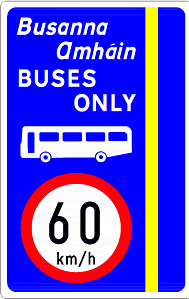
Bus Priority Facility Sign
While this sign shows, the hard shoulder is a bus priority facility: buses may drive on it at the limit set for it, and every other vehicle stays on the carriageway (Reg. 10A; S.I. No. 206 of 2026).
Some sign diagrams on this page come from the Irish Statute Book. Contains Oireachtas material, © Houses of the Oireachtas, reused under the Oireachtas (Open Data) PSI Licence (CC BY 4.0). Source: Houses of the Oireachtas, Oireachtas (Open Data) PSI Licence, clause 3.1, checked on 2026-09-15
Learner permit holders must not drive on a motorway
Source: Citizens Information, Learner permit rules for specific vehicle categories, dated 2025-09-29, checked on 2026-09-15
Motorway signs are the one group with no chapter of their own. Markings and electronic signs on a motorway are prescribed by the Road Traffic (Traffic Signs) Regulations 2025 (S.I. No. 433 of 2025, as amended by S.I. No. 205 of 2026), while the mainline direction signs sit in the directional information chapter of the Traffic Signs Manual and the start and end of motorway signs are detailed in its other information signs chapter. The rules a theory question tests come mostly from article 33 of the Road Traffic (Traffic and Parking) Regulations 1997 and from article 7 of the Roads Regulations 1994.
What article 33 stops you doing
The motorway rules are short and they are the ones questions come back to. Do not drive against the direction of traffic. Do not drive on or across any part of the motorway that is not a carriageway, which includes the hard shoulder, except in a parking or service area. Do not stop or park, unless an obstruction holds you up or you have had a crash or a breakdown, and then move left off the carriageway, call the Gardai from the nearest phone and stay no longer than you need to.
One lane rule sits with them: a vehicle whose own ordinary speed limit is 90 km/h or less, such as a goods vehicle over 3,500 kg or any vehicle towing, must keep out of the right-hand lane where there is more than one lane, unless an obstruction or a lane closure forces it over.
Who and what may use a motorway
Article 7 of the Roads Regulations 1994 lets a vehicle on a motorway only where it is driven by the holder of a driving licence for that vehicle, runs on pneumatic tyres, has an engine over 50 cc if it is petrol or diesel, and can hold 50 km/h on the level. Invalid carriages are excluded. A learner permit holder must not drive on a motorway.
Section 43 of the Roads Act 1993 keeps pedestrians, pedal cyclists and powered personal transporters such as electric scooters off a motorway, and animals must not be let on to one.
Two things the law does not say
No instrument we read sets a minimum driving speed for motorways. The only floor is the one in article 7 of the Roads Regulations 1994: the vehicle has to be capable of 50 km/h. If a question offers a minimum motorway speed as a legal figure, that is not in the instruments we could find.
No article we read bans reversing or a U-turn on a motorway in those words either. What the instruments do say is that you may not drive against the direction of traffic and may not drive on any part that is not a carriageway, which is where both manoeuvres fall down.
Buses on the hard shoulder
The newest motorway sign in Irish law turns a hard shoulder into a bus priority facility. The amending regulations inserted the variable sign RVMS 104 and the wide yellow line RRM 042, and a separate instrument applies the arrangement to a section of the M4, where the hard shoulder becomes a bus lane while the sign is displayed and carries its own special speed limit.
It is an exception to article 33, not a change to it. For every other driver the hard shoulder is still not a carriageway.
Sources
Source: irishstatutebook.ie, Road Traffic (Traffic Signs) Regulations 2025 (S.I. No. 433 of 2025), checked on 2026-09-16
Source: irishstatutebook.ie, Road Traffic (Traffic Signs) (Amendment) Regulations 2026 (S.I. No. 205 of 2026), checked on 2026-09-16
Source: irishstatutebook.ie, Road Traffic (Traffic and Parking) Regulations 1997 (S.I. No. 182 of 1997), checked on 2026-09-16
Source: irishstatutebook.ie, Roads Act 1993, section 43 (who may not use a motorway), checked on 2026-09-16
Source: irishstatutebook.ie, Roads Regulations 1994 (S.I. No. 119 of 1994), art. 7, checked on 2026-09-16
Source: irishstatutebook.ie, Road Traffic Act 2004, sections 5 to 9 (speed limits), checked on 2026-09-16